



Ramon Ruiz, born in Granada, is a Spanish composer, concert guitarist, recording artist and creative director. His talent comes from a long history of family relatives from Granada: His great-uncle Gabriel Ruiz Zuñiga was the guitarist of the Sextet Albeniz (Ángel Barrios) his grandfather played guitar, laud and bandurria for local celebrations in Granada and his father was a dedicated flamenco guitarist.
Ramon is now a highly established figure within the contemporary British flamenco circuit with unmistakably Andalusian roots and a training deeply grounded in the traditional flamenco craft: accompaniment, tablao, dance, and singing.He spent formative years in Seville, where he trained and worked extensively, including periods at Los Gallos, one of flamenco’s most important historic tablaos. That experience is immediately audible in his playing.
Although now strongly connected to the United Kingdom, Ramón represents a model of what might be called international flamenco, but one built from within the tradition rather than from the outside.
His playing reflects:
Ramón sounds like a musician who has spent countless hours immersed in the lived reality of flamenco: the resonance of heels, the tension of live performance, and the intensity of the stage. This experience fundamentally shapes his musical pulse. His style combines modern elegance with a clear connection to the recognisable flamenco language of Andalusia. What sets him apart is that he does not approach flamenco from a position of admiration alone; he plays as someone who has lived inside its mechanisms.
This is particularly evident in:
He is not simply a concert guitarist, he is a complete flamenco musician.
Within the British flamenco scene, particularly in London, Ramón holds a position of significant influence.
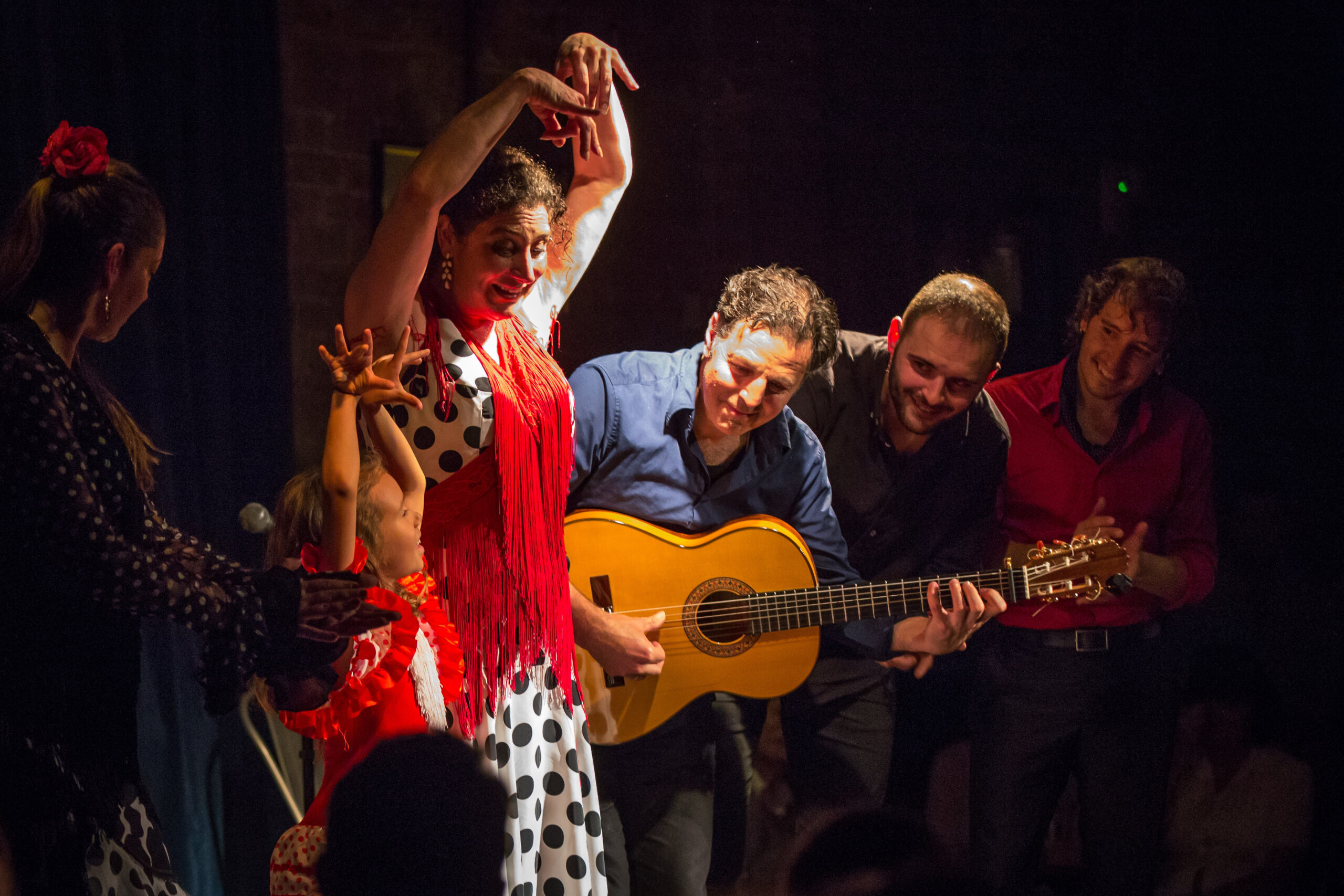
Ramon is a regular guest playing live on BBC Radio 3, he headlines in the top UK music venues and has been performing his own productions in The Jazz Cafe London for over 8 years, each time producing something new for his audience. He has also performed in The Royal Albert Hall, for the Royal Variety Show and on BBC TV, Canal Sur TV Spain.
He starred in The Mask of Zorro West End Production and has performed with world class artists including Anouscha Ravishankar, Hamza Namira and the Gypsy Kings. Ramon featured in “Song of Songs”, presented in London in 2024 receiving an Offie nomination in the category of best musical direction. He participated in Sky Guitar Star of the Year award for world-class guitarist. Other collaborations include artist director in the Indo-Flamenco production “Kalestu” funded by Arts Council, England and co-direction of the world class production “Flamenco from Spain” that is corruntly touring UK and Ireland.
Ramón recently recorded his third album Calle Lunga in Abbey Road Studios London, a masterpiece musical composition and arrangement.
He has also demonstrated a strong ability to navigate the UK artistic ecosystem, working within:
This adaptability reflects not only artistic skill but also organisational intelligence and long-term vision.
A defining aspect of Ramón’s work is his refusal to become confined within a static idea of flamenco “purity.”
Many flamenco artists abroad become fixed in a stylised, repetitive image of the genre. Ramón, by contrast, has actively pursued artistic evolution.
Examples include:
This approach reflects a deeper reality of flamenco itself: a tradition that has always evolved through cultural exchange, absorbing influences from Latin America, jazz, Arab music, classical harmony, and beyond.
Ramón belongs to a generation of Spanish musicians who have built sustained international careers without relying on celebrity status.
That achievement carries its own weight. It represents:
There is a quiet resilience in this trajectory—not the dramatic revolution of a figure like Paco de Lucía, but a slower, deeply rooted architectural development.
One of Ramón’s defining strengths is his understanding of the British audience.
Flamenco does not always translate directly across cultures. UK audiences often require:
Ramón has internalised this deeply. His performances are not simply guitar recitals—they are carefully shaped atmospheres.
Ramón Ruiz stands at an intersection:
His work demonstrates how flamenco can remain deeply rooted while evolving meaningfully across borders. His music beautifully expresses complex emotion, mastery and maturity with a unique yet instantly recognisable sound moving flamenco into a new exciting era.
For further information
For further information click here
With three standout albums under his belt and a new album out in February 2020, Ramon Ruiz is establishing himself as a leader of the scene and a master curator. In the radio interview his romantic nature was captured in the soulful sounds of La Peza, Ballada and Yunani played from the new album “Calle Lunga”.You may well be intoxicated by his unique mixing of classical, Middle Eastern, jazz and thematic music grounded with flamenco rhythms!
Julie Silverton writer and publisher of the book “Flamenco Forever”